Please ensure Javascript is enabled for purposes of website accessibility

Evergreen’s M&A and Cultural Lessons from Warren Buffett

Jeff Totten, our CEO, reflects on his long admiration of Warren Buffett, and him stepping down


Evergreen Team,

Every year I circulate my takeaways from the Berkshire Hathaway Annual Meeting. With the big news that Buffett shared on Saturday, it feels like a good time to reflect on my cumulative lessons learned from Warren Buffett.

Without further delay, here are my top 5 lessons from Warren Buffett:

  1. Do the right thing, always: “If you lose money for the firm, I will be understanding. If you lose a shred of reputation for the firm, I will be ruthless.” Buffett believes it takes decades to build a reputation, but that same reputation can be lost in five minutes. He sends a clear message through both his words and actions, that he expects everyone at Berkshire Hathaway to do the right thing, always, I have spoken to Berkshire managers multiple layers below Buffett and they often proactively bring up protecting Berkshire’s reputation before they talk about other priorities like growth or expanding profitability. Greg Abel cares deeply about Berkshire’s reputation and will ensure that Berkshire’s culture of doing the right thing persists long after Buffett steps down. Buffett sets an example for living modestly and giving back. He pledged to give 99% of his wealth back to philanthropic causes and convinced many peers to follow his lead. At the 2024 annual meeting, he put it well by saying that if you’re lucky in life, you should make sure a bunch of other people are lucky too.
  2. Never underestimate the power of compounding: “Our favorite holding period is forever.” Buffett compounded Berkshire at a 20% annual rate for 60 years and grew the Buffett Partnership at an even higher rate starting in 1957. He maximized both variables in the compounding equation: rate of return and time. Time is the exponent in the compounding equation, so it’s impact is literally exponential. He never interrupted his compounding by selling prematurely, and as a result, Berkshire accrued an $86 billion deferred tax liability which effectively served as a zero-cost form of financing that supplements its negative cost float. Compounding at a 20% rate for 69 years turns $1 million into $291 billion – it’s an unprecedented result.
  3. Surround yourself with the right people: “You will go in the direction of the people that you associate with.” Buffett surrounded himself with the best possible partners and mentors. His partner, Charlie Munger, shaped Berkshire’s investment philosophy and made Buffett a sharper decisionmaker and better person. Berkshire’s operations are highly decentralized and operate with an unparalleled level of autonomy because Buffett only partnered with operating CEOs who he could trust. Susie Buffett influenced his charitable philosophy which ultimately led to enormous philanthropic contributions.
  4. Prepare your mind and your balance sheet: “Be fearful when others are greedy and greedy when others are fearful.” Everyone knows the quote, but few appreciate what it takes to practice Buffett’s advice. It comes down to temperament and preparation. Buffett spends market booms on the sidelines letting cash pile up, reading 500 pages per day and asking business leaders who their best and worst competitors are to generate investment ideas and a knowledge base of references. When a dislocation inevitably occurs, he is ready to act quickly because he has context on most companies in his circle of competence and capital at the ready from his fortress balance sheet. He is constantly preparing himself and the company to act swiftly when the opportunity arises.
  5. Long-term investing: “only buy something that you would be perfectly happy to hold if the market shut down for 10 years.” Buffett taught us how to seek companies with economic moats, the importance of partnering with CEOs who you can trust and the value of low-cost capital in the form of insurance float and deferred taxes. He consistently found opportunities to invest capital in durable companies in the rare moments when they traded at a discount. He kept learning and adapting as the world changed. He started as a cigar-butt investor trained by Benjamin Graham, but it discovered the importance of business quality with his investment in See’s Candy. He paid $25 million for See’s and Berkshire went on to collect $2 billion of dividends from the company over the next several decades. At the ripe age of 86, he invested in Apple and generated a ~$150 billion gain on a ~$40 billion investment.


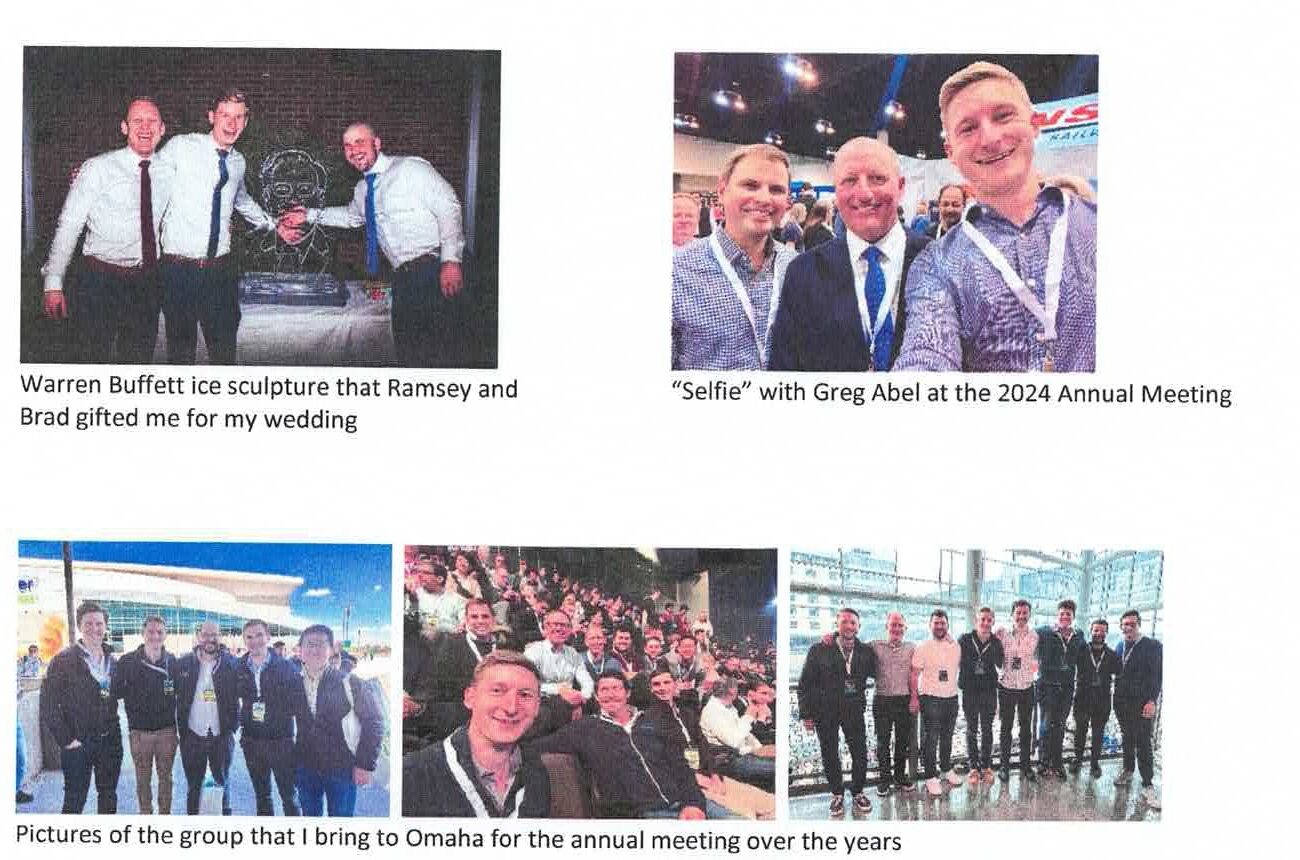
I got a little emotional in conversations with my wife, Susie, and with Ramsey on Saturday about Buffett stepping down. Even though I have never met him, I see him as one of my mentors and role models.

Most of all, I feel tremendous gratitude for the example that he set and the lessons that he taught. He is one of a kind and his positive impact on the world is immeasurable. Thank you, Warren Buffett!
long term investing advice